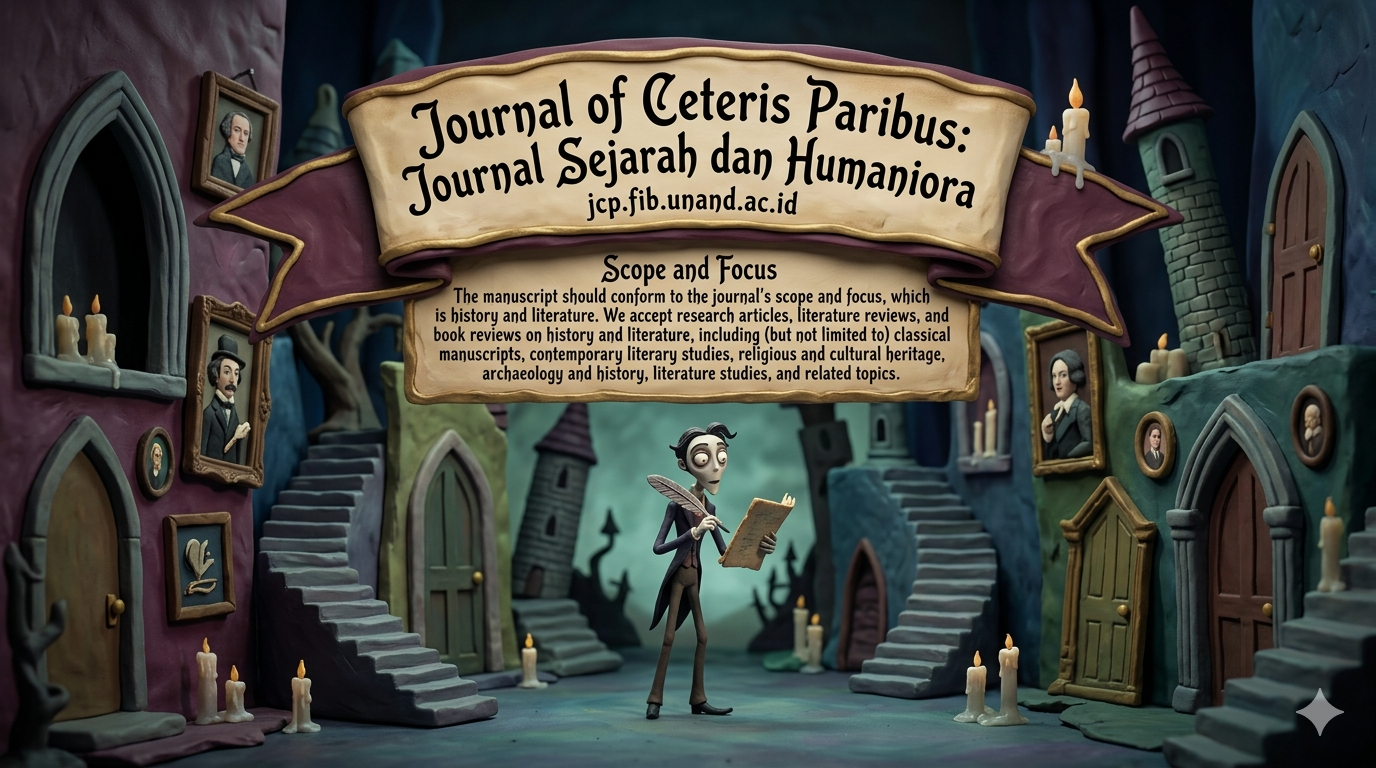
Aims and Scope
Aims
JCP aims to advance critical, evidence-based scholarship in history and literature, and to make research from Indonesia, Southeast Asia, and comparative studies elsewhere visible to an international readership. The journal values work that makes a clear scholarly contribution through rigorous use of primary sources and texts, explicit method, and engagement with current debates. The subject focus of JCP is history and literature, together with manuscript and textual studies, cultural and religious heritage, and archaeology as it relates to historical interpretation. The word “Humaniora” in the journal’s title refers to these humanities fields.
Scope
- History: Indonesian, Southeast Asian and comparative history; social, cultural, political, economic, intellectual, local and regional history; history from below; oral history; historiography, biography, memory and the theory and method of history.
- Literature: contemporary and classical literature in Indonesian, regional and world languages; oral and traditional literature; literary theory, criticism and comparative literature.
- Manuscript and textual studies: philology, classical manuscripts, textual transmission and editing.
- Cultural and religious heritage: religious and cultural heritage, heritage and memory studies, and archaeology as it relates to historical interpretation.
Approaches and geography
All historical and literary approaches are welcome, including interdisciplinary work, provided a historical or literary question is at its core. The journal has no geographic limit. Studies of Indonesian and Southeast Asian subjects are well represented; they should state their wider significance for the field.
Article types
- Research article (6,000–8,000 words excluding references): original research with a clear argument, method, and sources.
- Literature review/ review article: critical synthesis that advances the field, not a summary.
- Review essay and book review (6,000 words excluding references): critical assessment of one or more recent scholarly works.
- Special issue or forum article: by call or editorial invitation; reviewed like all other articles.
- Editorial: written by the editors; not peer-reviewed and labeled as such.
Not accepted
Manuscripts outside history and literature; purely descriptive or chronicle accounts without analysis; textbooks and teaching materials; manuscripts already published or under review elsewhere; and manuscripts that fail the ethics, plagiarism, or generative AI policies.
Article types and peer review
|
Section |
Description |
Length (excluding references) |
Review |
|
Research Article |
Original research with a clear argument, method, and sources |
6,000–8,000 words |
Double-blind peer review, at least two reviewers |
|
Review Article |
Critical literature review or historiographical synthesis that advances the field |
6,000–8,000 words |
Double-blind peer review, at least two reviewers |
|
Book Review |
Critical assessment of one or more recent scholarly works (review essays included) |
2,500–4,000 words |
Double-blind peer review, at least two reviewers |
|
Special Issue / Forum Article |
Thematic collection by call or editorial invitation |
As above, by article type |
Same peer review as regular articles; clearly labeled |
|
Editorial |
Written by the editors |
Short |
Not peer-reviewed; clearly labeled |
Languages
Manuscripts may be submitted in Indonesian or English. English is preferred. All manuscripts must include an English abstract.