As part of the submission process, authors are required to check off their submission's compliance with all of the following items, and submissions may be returned to authors that do not adhere to these guidelines.
The submission has not been previously published, nor is it before another journal for consideration (or an explanation has been provided in Comments to the Editor).
The submission file is in OpenOffice, Microsoft Word, or RTF document file format.
Where available, URLs for the references have been provided.
The text adheres to the stylistic and bibliographic requirements outlined in the Author Guidelines.
As part of the submission process, authors are required to check off their submission's compliance with all of the following items, and submissions may be returned to authors that do not adhere to these guidelines. The paper complies with the focus and scope of the journal
The article has significant contributions to science (covering aspects of suitability, authenticity and high novelty).
The paper has a compelling title (concise, straightforward, valid).
The abstract is concise (no more than 250 words), has a complete component (goals, methods, results, conclusions) and relevant keywords.
The results and discussion is compliance with the purpose of writing and has clear and comprehensive interpretation.
The paper uses the relevant sources and has consistent and complete citations.
The language of the article is clear and communicative.
The typing format and the total number of pages according to the template.
Author Guidelines
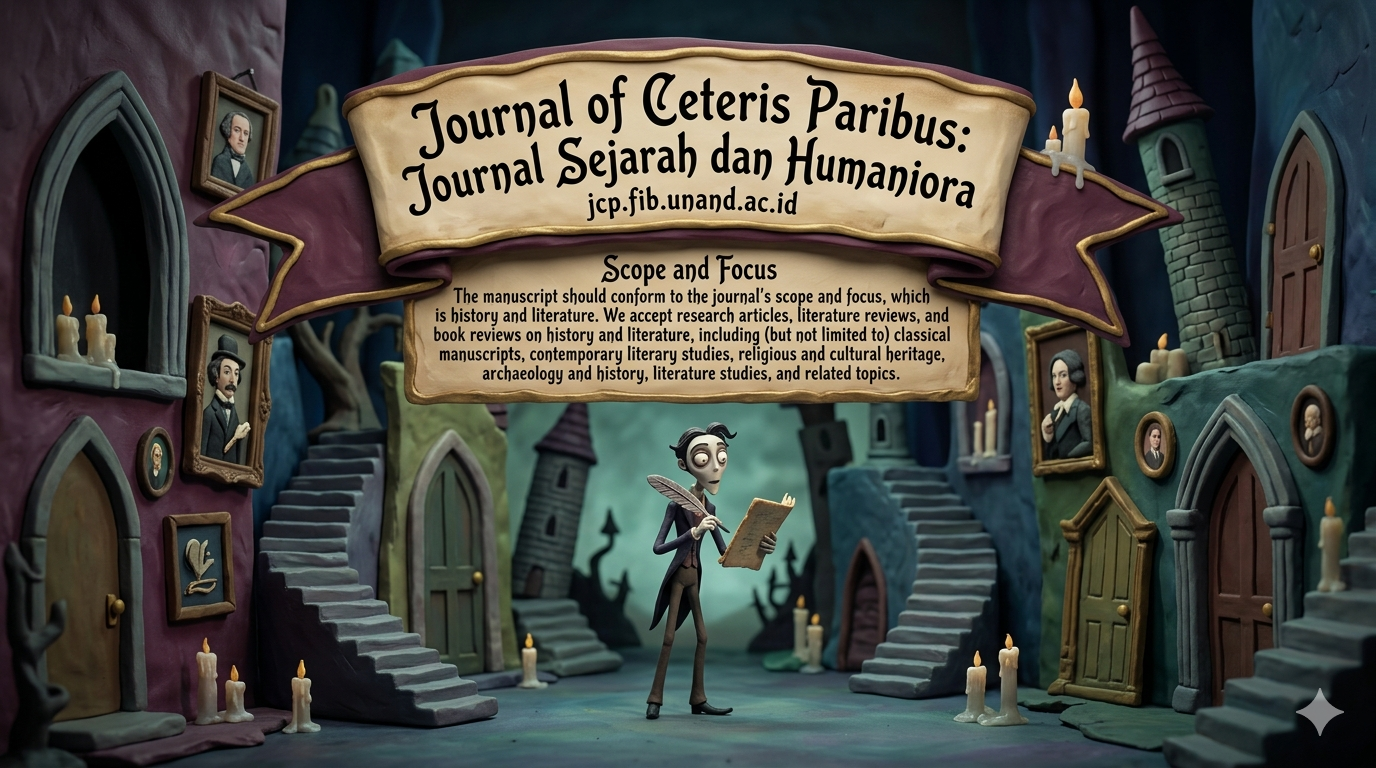
AUTHOR GUIDELINES • Journal of Ceteris Paribus: Journal Sejarah dan Humaniora is a semi-annual journal published in June and December. • Submitted articles should not have been published or be under consideration/review elsewhere. • Authors should adhere to the following guidelines: • APC is free. ■ Scope and Focus The manuscript should conform to the journal’s scope and focus, which is history and literature. We accept research articles, literature reviews, and book reviews on history and literature, including (but not limited to) classical manuscripts, contemporary literary studies, religious and cultural heritage, archaeology and history, literature studies, and related topics. ■ Similarity Index The similarity index of the manuscript should not exceed 20%. ■ Manuscript Structure/format The manuscript may be written in Indonesian or English, in accordance with correct written usage, and should be 6000-8000 words (excluding references). However, English is preferable. The manuscript structure should include the title, abstract, keywords, introduction, methods, findings/results, discussion, conclusion, acknowledgment (optional), and references. It was typed in a MS Word doc./docx. format, using 12-size Times New Roman fonts, 1 space on A4-size paper. ⎫ The title of the manuscript should be short and clear, with a maximum of 15 words; it should not have multiple interpretations; it should not contain abbreviations that are uncommonly used. ⎫ Abstract is written in English in 150-200 words, which contain purpose/objective, method, result/finding, and discussion, conclusion. ⎫ Keywords are in 3-5 words. 2 or 3 words are taken from the title. Keywords should be commonly searchable terms. ⎫ Introduction (600-800 words) explains the importance of the topic, relevant previous research, research problems, and the significance of the research. ⎫ Method (300-400 words) describes the research approach, theories or concepts, description of participants (corpus/object being studied), instrumentation, data collecting procedures, and data analysis. ⎫ Results/findings and Discussion (4800-6800 words) explain the findings of the research questions or problems. The Discussion is focused on the analysis and study in accordance with the theory or concept used. The number of subheadings should at least follow the number of research questions/issues. ⎫ Conclusion (300-400 words) is the synthesis of findings and theories, implications, and recommendations. ⎫ References should be at least 20 sources, consisting of books (within the last 10 years) and journal articles (within the last 5 years). • Articles will be reviewed by subject reviewers, while the editors reserve the right to edit articles for format consistency without altering the substance. ■ Table and Figure/chart The number of tables and figures should not exceed five, and should be placed as close as possible to where you first refer to them. The name/title of the table should be written in TNR 11 and put directly above the table, and the content of the table must be written in TNR 10. The name/title of the figure/chart should be written in TNR 11, put directly below the figure/ chart. ■ Citation and References ● The manuscript should contain at least 20 good-quality references (15 articles and 5 books). ● All references and in-text citations should be in APA 7th edition. Not-cited sources should not be put in the reference list. ○ Paper and Margins The manuscript should be written on A4 paper with top and left margins of 3 cm, and right and bottom margins of 3 cm. ○ Files to submit There are at least two files that must be submitted: 1) the original file contains the manuscript (see the manuscript template); and 2) the supplementary file contains the title page and guarantee form (see title page and guarantee form template). ○ Miscellaneous ● Arabic Romanization should follow the Library of Congress Guidelines. ● The manuscript submitted should be in Word format, not in PDF. ● Download the template for the proper structure of manuscript writing. ● Before submitting the manuscript, check its consistency with the author guidelines using the following rubric. IT IS SUGGESTED THE USE OF A REFERENCE MANAGER, MENDELEY AND ZOTERO.
Copyright Notice
Copyright Statement
1. Right of Authors
JCP allow the author(s) to hold the copyright. Authors retain all their rights to the published works, such as (but not limited to) the following rights:
Copyright and other proprietary rights relating to the article, such as patent rights;
The right to use the substance of the article in own future works, including lectures and books;
The right to reproduce the article for own purposes;
The right to self-archive the article;
The right to enter into separate, additional contractual arrangements for the non-exclusive distribution of the article's published version (e.g., post it to an institutional repository or publish it in a book), with an acknowledgment of its initial publication in this journal (JCP).
2. Co-Authorship
If the article was jointly prepared by other authors, any authors submitting the manuscript warrants that he/she has been authorized by all co-authors to be agreed on this copyright and license notice (agreement) on their behalf, and agrees to inform his/her co-authors of the terms of this policy. JCP will not be held liable for anything that may arise due to the author(s) internal dispute. JCP will only communicate with the corresponding author.
3. Royalties
This agreement entitles the author to no royalties or other fees. To such extent as legally permissible, the author waives his or her right to collect royalties relative to the article in respect of any use of the article by JCP.
4. User Right
JCP permits users to copy, distribute, display, and perform the work for non-commercial and ShareAlike purposes only. Users will also need to attribute authors and JCP on distributing works in the journal.