Peer Review Process
Last updated: 9 November 2026. Effective from: 9 November 2026.
1. Model
JCP uses double-anonymous peer review. Reviewers do not know the authors’ identities, and authors do not know the reviewers’ identities. Authors must remove their names, affiliations, acknowledgments, and file-property metadata from the main manuscript; self-citations are written in the third person. The editorial office checks files before sending them to reviewers. Every research article, review article, review essay and book review is peer reviewed. Editorials are reviewed by the editorial board and labeled as such.
2. Stages
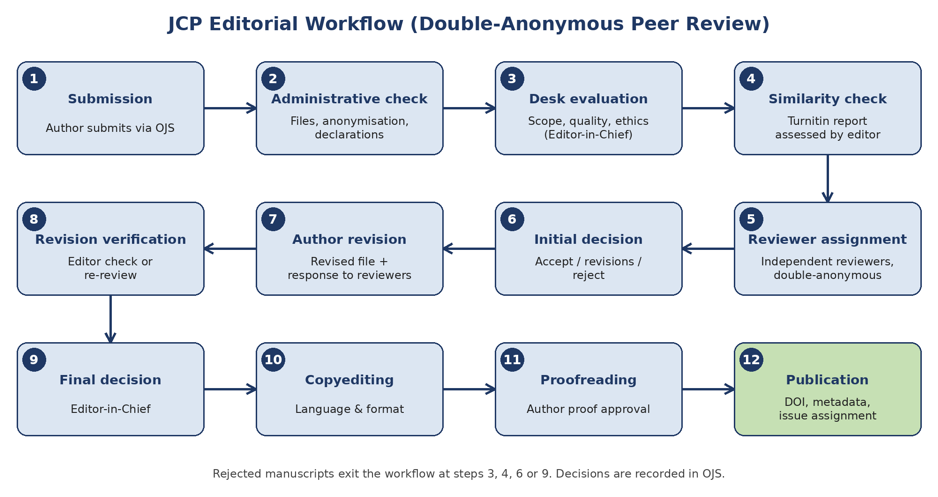
- Administrative check: completeness of files, template, anonymization, title page and declaration form.
- Desk evaluation: The Editor-in-Chief or a section editor checks fit with the Aims and Scope, scholarly contribution, and compliance with ethics policies. Manuscripts may be rejected at this stage without external review.
- Similarity check: Turnitin is used on the submitted manuscript and again on the final version before publication. The editor assesses the report substantively; see Plagiarism and Similarity Policy.
3. Reviewer selection and invitation
Each manuscript is sent to two independent reviewers chosen for their expertise in the topic, as evidenced by their publications. At least one reviewer should be from an institution different from the authors’ where possible. Invitations state the title, abstract, and deadline. A reviewer accepts only after confirming there is no conflict of interest and agrees to treat the manuscript confidentially. Reviewers are asked to return reports within 2–4 weeks. Reviewers who cannot meet the deadline are replaced.
4. Review criteria
Reviewers assess originality and contribution; fit with scope; clarity of argument and research questions; method and use of primary sources or texts; engagement with current scholarship; structure and clarity; accuracy of references; ethical conduct; and language quality.
5. Recommendations and decisions
Reviewers recommend one of: accept, minor revisions, major revisions, or reject, with written comments for the authors and, optionally, confidential comments to the editor. Reviewers advise; the Editor-in-Chief makes the final decision on the basis of the reports and the editor’s own reading, and records the reasons in OJS.
6. Revision and re-review
Authors submit a revised manuscript with a point-by-point response within ten days. The editor verifies minor revisions. Major revisions are returned to the original reviewers where possible. A further round may be requested.
7. Conflicting reports and third reviewer
When reports conflict, the editor may invite a third reviewer or an editorial board member as adviser. The Editor-in-Chief decides and explains the reasoning in the decision letter. The number of reviewers used is not a vote count.
8. Conflicts of interest and confidentiality
Reviewers must decline if they have a recent collaboration, shared institution, supervisory, financial or personal relationship with an author, or if they cannot be impartial. Editors with such a relationship hand the manuscript to another editor. Manuscripts, reviews and decisions are confidential. Reviewers must not use unpublished material for their own work, and must not upload manuscripts to generative AI tools (see Generative AI Policy).
9. Manuscripts by editors, board members and staff
A manuscript authored or co-authored by the Editor-in-Chief, a managing editor, a section editor, an editorial board member or secretariat staff is handled by an independent editor with no relationship to the authors. The author-editor is blocked from all access to the manuscript’s record in OJS, including reviewer identities and decisions. The article states: “This article was handled by [name], who has no affiliation with the authors.” The same applies to guest editors of special issues.
10. Records
OJS keeps reviewer assignments, invitation dates, reports, decisions, and similarity reports in the editorial archive for three years.
11. Appeals
Authors who disagree with a decision follow the Complaints and Appeals procedure.