
DOMESTIC GEOPOLITICS AND EFFECTIVE SABOTAGE: THE POWER NEGOTIATIONS OF "ORANG DAGANG" IN KABA LAREH SIMAWANG BY SYAMSUDDIN ST. RADJO ENDAH
Article Sidebar
Main Article Content
Abstract
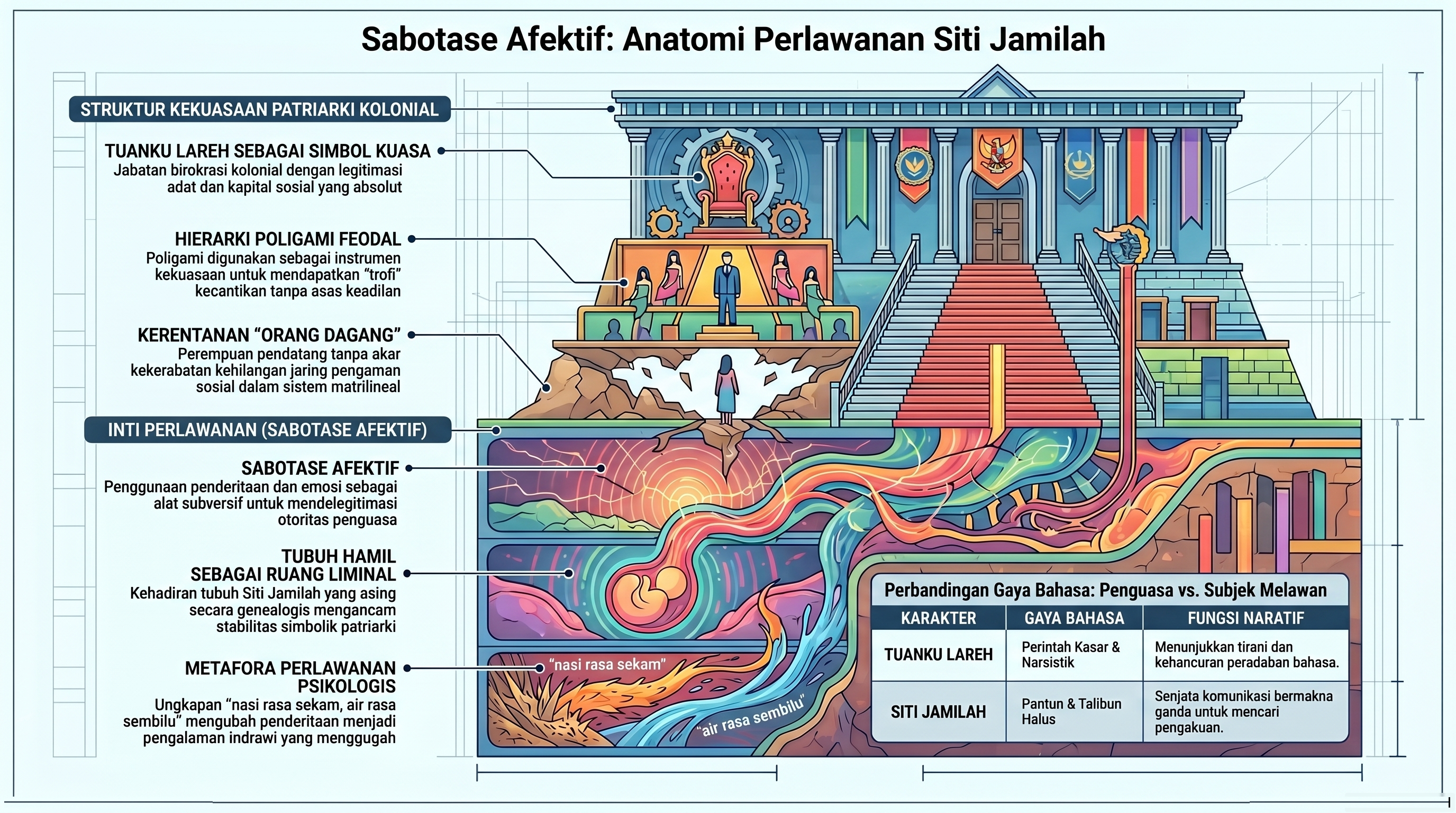
This research addresses a gap in the study of Minangkabau kaba literature, which has long positioned women as marginal subjects. It argues that Siti Jamilah in Kaba Lareh Simawang by Syamsuddin St. Radjo Endah performs affective sabotage as a form of structural resistance against polygamy and colonial patriarchal power. Employing a sociocritical method, this study analyzes themes, social elements, and traces of historical events within the kaba to understand the social structures and problems it reflects. Siti Jamilah's vulnerability as an "orang dagang" (outsider) constitutes affective sabotage whose explosive force delegitimizes the moral authority and bureaucratic-masculine position of the Lareh—transcending the passivity stigma of misogynistic readings. Her suffering is not a weakness but a subversive instrument: her pregnant body and cultural alienation become the most threatening liminal space for the stability of colonial patriarchal power in Minangkabau. These findings contribute to sociocritical literary studies and gender studies in the context of matrilineal-colonial societies, demonstrating that women's bodies and suffering are not spaces of defeat, but the most intimate and dangerous arenas of power negotiation.
Article Details

This work is licensed under a Creative Commons Attribution-NonCommercial-ShareAlike 4.0 International License.




References
Abdullah, T. (1972). Modernization in the Minangkabau World: West Sumatra in the Early Decades of the Twentieth Century. In Claire Holt (Ed.), Culture and Politics in Indonesia. Cornell University. https://doi.org/10.7591/9781501743900-009 DOI: https://doi.org/10.7591/9781501743900-009
Abdurahman, Hayati, Y., Manaf, N. A., Handrianto, C., & Azhar, N. F. N. (2024). Gender Roles in Traditional and Modern Minangkabau Kaba: An Analysis of Ten Selected Narratives. Theory and Practice in Language Studies, 14(11), 3504–3514. https://doi.org/10.17507/tpls.1411.19 DOI: https://doi.org/10.17507/tpls.1411.19
Andatu, A. (2023). Poligami dalam Novel Merantau ke Deli Karya Hamka: Pendekatan Sosiologi Sastra. Jurnal Ilmiah KORPUS, 7(1), 142–148.
Asnan, G. (2006). Pemerintahan Daerah Sumatera Barat: Dari VOC Hingga Reformasi. Citra Pustaka.
Dobbin, C. (2008). Gejolak Ekonomi, Kebangkitan Islam, dan Gerakan Paderi Minangkabau 1784-1847. Komunitas Bambu.
Graves, E. E. (2007). Asal-usul Elite Minangkabau Modern: Respons terhadap Kolonial Belanda Abad XIX/XX. Yayasan Obor Indonesia.
Hyndman, J. (2004). Mind the Gap: Bridging Feminist and Political Geography. Political Geography, 23(3), 307–322. DOI: https://doi.org/10.1016/j.polgeo.2003.12.014
Kristeva, J. (1982). Powers of Horror: An Essay on Abjection. Columbia University Press.
Massey, D. (1994). Space, Place, and Gender. University of Minnesota Press.
McGann, J. J. (1988). The Beauty of Inflections: Literary Investigations in Historical Method and Theory. Oxford University Press. https://doi.org/10.1093/acprof:oso/9780198117506.001.0001 DOI: https://doi.org/10.1093/acprof:oso/9780198117506.001.0001
Muhardis, & Fitrina, Y. (2023). Metaphors in Kaba Tuanku Lareh Simawang Story. JOALL (Journal of Applied Linguistics and Literature), 8(2), 338–354. https://doi.org/10.33369/joall.v8i2.27540 DOI: https://doi.org/10.33369/joall.v8i2.27540
Mutolib, A., Yonariza, Mahdi, & Ismono, H. (2016). Gender Inequality and the Oppression of Women within Minangkabau Matrilineal Society: A Case Study of the Management of Ulayat Forest Land in Nagari Bonjol, Dharmasraya District, West Sumatra Province, Indonesia. Asian Women, 32(3), 23. https://doi.org/10.14431/aw.2016.09.32.3.23 DOI: https://doi.org/10.14431/aw.2016.09.32.3.23
Rosa, S., Suryani, N., Marni, S., Fitrisia, A., Olivia, L., & Ilham, R. (2026). Voices of Matriliny and Hidden Power: Reimagining Female Agency through Minangkabau Narratives in Kaba and Tambo. Social Sciences & Humanities Open, 13, 102531. https://doi.org/10.1016/j.ssaho.2026.102531 DOI: https://doi.org/10.1016/j.ssaho.2026.102531
Spivak, G. C. (1988). Can the Subaltern Speak? In C. Nelson & L. Grossberg (Eds.), Marxism and the Interpretation of Culture (pp. 271–313). University of Illinois Press.
Stevenson, Y. (2016). Kaba Lareh Simawang sebagai Konsep Dasar Penciptaan Tari Laki-Laki. Ekspresi Seni, 18(1), 78–95. https://doi.org/10.26887/ekse.v18i1.85 DOI: https://doi.org/10.26887/ekse.v18i1.85
Thalita, M. D. (2020). Muslimah Kelas Menengah Berbagi Suami: Studi Kasus Keluarga Poligami di Daerah Istimewa Yogyakarta. Al-Ahwal: Jurnal Hukum Keluarga Islam, 12(2), 184–197. https://doi.org/10.14421/ahwal.2019.12206 DOI: https://doi.org/10.14421/ahwal.2019.12206
Turner, V. (1969). The Ritual Process: Structure and Anti-Structure. Aldine Publishing.
Velini, R. S., & Nirmala, D. (2021). Environmental Metaphors in Randai Traditional Performance in Minangkabau: Ethnographic Study. E3S Web of Conferences, 317, 01050. https://doi.org/10.1051/e3sconf/202131701050 DOI: https://doi.org/10.1051/e3sconf/202131701050
Weedon, C. (1987). Feminist Practice and Poststructuralist Theory. Blackwell.
Yousefian, N., & Foroughi, H. (2022). Sociocritical Analyse of Ebn Machghaleh by Nader Ebrahimi. Research in Contemporary World Literature, 26(2), 593–620. https://doi.org/10.22059/jor.2019.288714.1892.