TRACE, CRITIQUE, AND JUSTICE: A RICOEURIAN FRAMEWORK FOR ETHICAL HISTORIOGRAPHY OF TRAUMATIC MEMORY
Article Sidebar
Main Article Content
Abstract
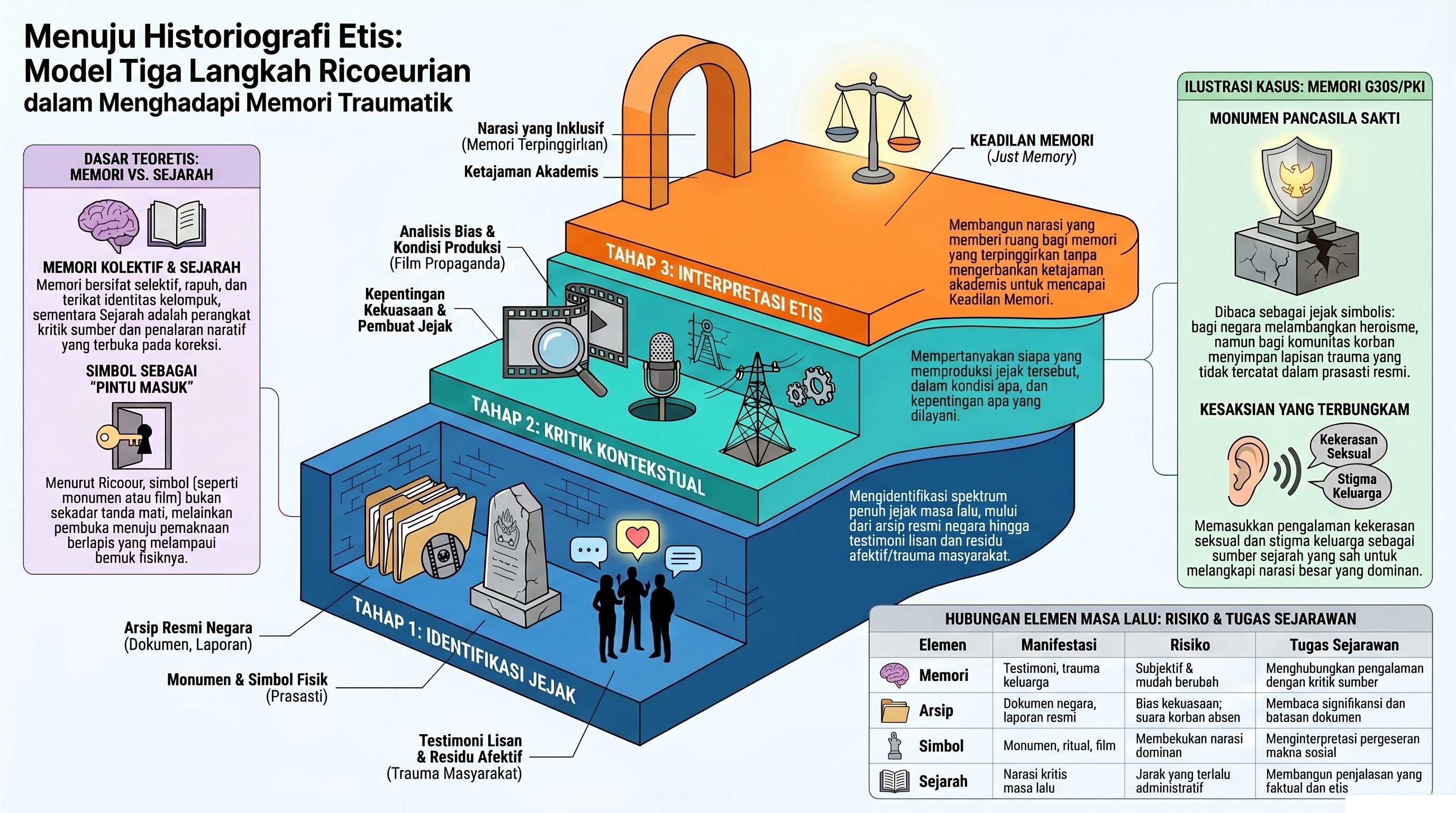
This article offers a theoretical synthesis exploring the relationship between Paul Ricoeur's hermeneutic phenomenology, collective memory, symbols, and historical events. It addresses a persistent gap in the scholarship: while Ricoeurian hermeneutics has been widely invoked in philosophy and literary studies, a replicable operational framework that bridges archival historiography, collective memory theory, and ethical interpretation has yet to be systematically formulated. This article fills that gap by proposing a three-step model—trace identification, contextual critique, and ethical interpretation—as a methodological contribution for historians navigating contested traumatic narratives. Memory provides lived experience, testimony, and the affective residue of the past; history offers source criticism, contextualization, and narrative reasoning to prevent memory from becoming a closed and singular claim. Following Ricoeur, symbols are not inert signs but openings toward layered interpretation. The article illustrates this framework through the case of G30S/PKI collective memory in Indonesia—a paradigmatic instance of traumatic memory polarization in Southeast Asia—to demonstrate how the proposed model can be operationalized on monuments, state-produced films, and silenced testimonies.
Article Details

This work is licensed under a Creative Commons Attribution-NonCommercial-ShareAlike 4.0 International License.




References
Assmann, A. (2011). Cultural Memory and Western Civilization: Functions, Media, Archives. Cambridge University Press.
Assmann, J., & Czaplicka, J. (1995). “Collective memory and cultural identity”. New German Critique, (65), 125–133. DOI: https://doi.org/10.2307/488538
Jones, S. (2015). Lucy Bond & Jessica Rapson. The Transcultural Turn: Interrogating Memory Between and Beyond Borders: Berlin & Boston: de Gruyter, 2014. Témoigner. Entre Histoire et Mémoire, 121, 167–169. https://doi.org/10.4000/temoigner.3749. DOI: https://doi.org/10.4000/temoigner.3749
Connerton, P. (1989). How Societies Remember. Cambridge University Press. DOI: https://doi.org/10.1017/CBO9780511628061
Cordonnier A, Rosoux V, Gijs A-S, Luminet O. Collective memory: An hourglass between the collective and the individual. Memory, Mind & Media. 2022;1:e8. doi:10.1017/mem.2022.1 DOI: https://doi.org/10.1017/mem.2022.1
Craps, S. (2022). Postcolonial Witnessing: Trauma Out of Bounds. Palgrave Macmillan.
Erll, A. (2017). Memory in Culture (S. B. Young, Trans.). Palgrave Macmillan.
Halbwachs, M. (1992). On Collective Memory (L. A. Coser, Ed. & Trans.). University of Chicago Press. DOI: https://doi.org/10.7208/chicago/9780226774497.001.0001
LaCapra, D. (2001). Writing History, Writing Trauma. Johns Hopkins University Press.
Lowenthal, D. (1985). The Past is a Foreign Country. Cambridge University Press.
McGregor, K. E. (2007). History in Uniform: Military Ideology and the Construction of Indonesia's Past. NUS Press.
Munsi, H. (2016). Dari masa lalu ke masa kini: Memori kolektif, konstruksi negara dan normalisasi anti-komunis. ETNOSIA: Jurnal Etnografi Indonesia 1(1), 30–43. https://doi.org/10.31947/etnosia.v1i1.998 DOI: https://doi.org/10.31947/etnosia.v1i1.998
Nora, P. (1989). Between memory and history: Les lieux de mémoire. Representations, 26, 7–24. DOI: https://doi.org/10.2307/2928520
Pohlman, A. (2015). Women, Sexual Violence and the Indonesian Killings of 1965–66. Routledge. DOI: https://doi.org/10.4324/9781315818795
Ricoeur, P. (1967). The Symbolism of Evil (Vol. 18). Beacon Press.
Ricoeur, P. (1983). Time and Narrative (Vol. 1) (K. McLaughlin & D. Pellauer, Trans.). University of Chicago Press. DOI: https://doi.org/10.7208/chicago/9780226713519.001.0001
Ricoeur, P. (2004). Memory, History, Forgetting. University of Chicago Press. DOI: https://doi.org/10.7208/chicago/9780226713465.001.0001
Rigney, A. (2018). Remembering hope: Transnational activism beyond the traumatic. Memory Studies, 11(3), 368–380. DOI: https://doi.org/10.1177/1750698018771869
Roosa, J. (2006). Pretext for Mass Murder: The September 30th Movement and Suharto's Coup d'État in Indonesia. University of Wisconsin Press. DOI: https://doi.org/10.2307/jj.36106153
White, H. (1973). Metahistory: The Historical Imagination in Nineteenth-Century Europe. Johns Hopkins University Press.