THE COQUETTE’S PRISON: ROSALIE MURRAY AND THE FAILURE OF HIGH-SOCIETY MARRIAGE AS A PATH TO AUTONOMY
Article Sidebar
Main Article Content
Abstract
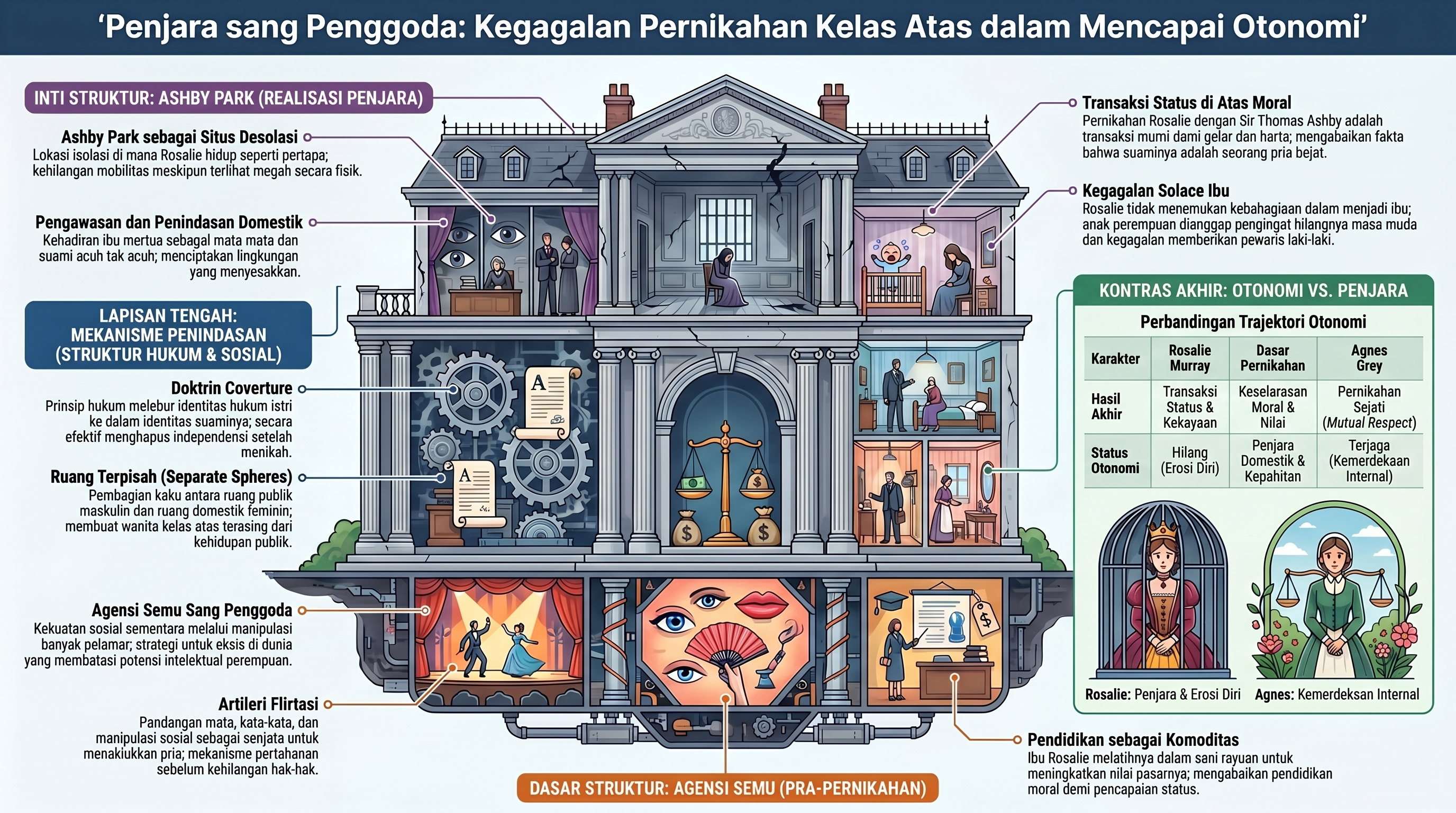
Research on women's agency in Victorian literature typically focuses on the marginalized figure of the governess. At the same time, the upper-class coquette—who appears to wield power—remains overlooked in critical readings as a victim of systemic oppression. This research examines the coquette’s prison in Anne Brontë’s Agnes Grey, specifically analyzing how Rosalie Murray’s pursuit of high-society marriage serves as a mechanism of self-erasure rather than a path to autonomy. The study employs a qualitative approach rooted in feminist literary criticism and historical realism. The data consist of textual evidence from the novel, analyzed through close reading and character-comparative analysis. The research evaluates the transition from pre-marital performative power to post-marital domestic entrapment. The results indicate that Rosalie’s flirtatious artillery provides only a temporary and illusory agency. Upon marrying Sir Thomas Ashby for rank and wealth, she experiences a catastrophic loss of freedom, becoming a prisoner and a slave within the physical and psychological enclosures of Ashby Park. The research concludes that Victorian high-society marriage, when divorced from moral compatibility, leads to psychological petrifaction. Further studies are recommended to employ a digital humanities approach to map motifs of spatial and psychological confinement across the broader canon of the Brontës and to identify systemic patterns of gender inequality.
Article Details

This work is licensed under a Creative Commons Attribution-NonCommercial-ShareAlike 4.0 International License.




References
Ahmad, A. (2015). The Victorian governess novel and the ethics of care. Palgrave Macmillan.
Berry, L. (2011). Anne Brontë and the Victorian family. Journal of Victorian Culture, 16(2), 210–225.
Botelho, C. (2025). The priceless treasure at the bottom of the well: Rereading Anne Brontë [Doctoral dissertation, University of Pretoria].
Brontë, A. (1847). Agnes Grey. Thomas Cautley Newby.
Carnell, R. (2014). Anne Brontë’s hard realism. The Brontë Society Transactions, 39(1), 1–15.
Gordon, J. (2022). Entrapment and enclosure in Brontë’s fiction. Victorian Literature and Culture, 50(3), Article e25. [Note: Add specific page range if known].
Langland, E. (2012). Anne Brontë’s Agnes Grey: The governess as author. Victorian Literature and Culture, 40(1), 19–30. [Note: Add specific page range if known].
Lecaros, C. W. (2011). The Victorian governess novel. Lund University. [Note: If this is a dissertation, specify the degree in brackets].
Poovey, M. (2014). Uneven developments: The ideological work of gender in mid-Victorian England. University of Chicago Press.
Simonton, D. (2017). The Routledge history of women in Europe since 1700. Routledge.
Summers, A. (2025). The contest of marriage: Domestic authority in the Victorian novel [Doctoral dissertation, University of Kentucky].
Ward, I. (2013). Literature and the legal imagination and the Brontës. Oxford University Press.